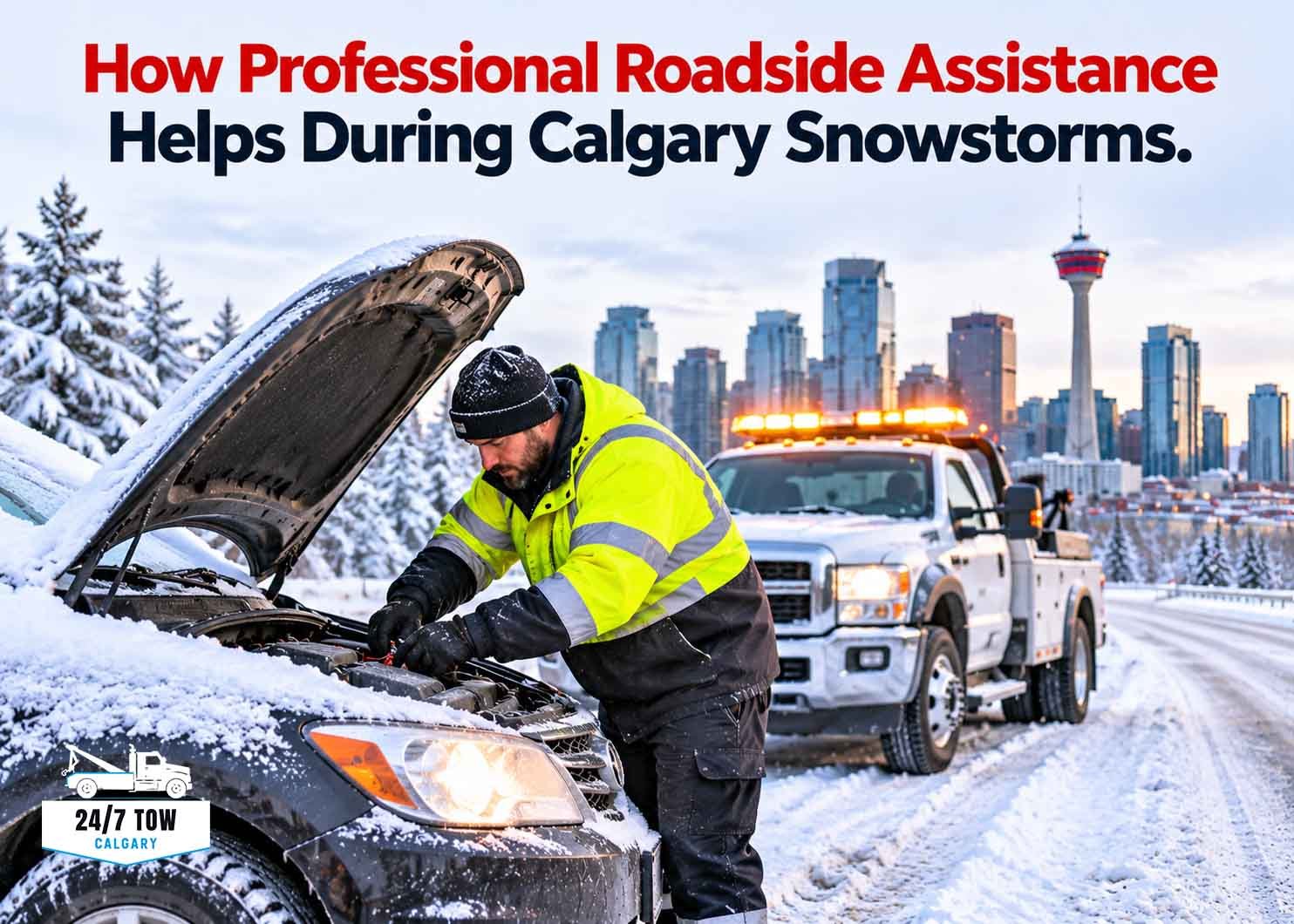


A car dies on Deerfoot Trail at 5:15 p.m. in January. Traffic is packed, the light is gone, and the temperature is dropping fast.
Nobody plans for this moment. Most drivers have no tow number saved and no idea what to say when someone answers. That is how people end up on hold, stuck in the cold, or accepting the first truck that shows up.
This guide explains how emergency towing Calgary drivers rely on actually works. You will learn what to do in the first five minutes, what to tell the dispatcher, and what to expect on price. Our team at 24/7 Tow Calgary sees these calls every day, so the advice comes from real roadside situations.
What Counts as an Emergency Towing Situation?
A tow is an emergency when your vehicle is unsafe to leave, blocking traffic, or cannot be driven. If staying put puts you or others at risk, call right away.
Not every breakdown needs a rush response. A flat tire in your driveway can wait until morning. A stalled car in a live lane cannot.
These are the most common emergency calls in Calgary:
- A collision that leaves the vehicle undriveable
- Engine failure or overheating on a busy road
- A car stuck in deep snow, mud, or a ditch
- A dead battery in extreme cold with no safe place to wait
- A vehicle blocking a lane, driveway, or intersection
- A rollover or off-road slide
- Mechanical failure on a highway shoulder
Some of these are tow jobs. Others, like a dead battery or an empty tank, may only need a quick fix on the spot. A good dispatcher will tell you which one you have. If you only need a jump, car battery boost can get you moving without a tow. If you ran out of gas, fuel delivery handles it.
What Should You Do First When Your Vehicle Breaks Down?
Get to a safe spot, turn on your hazard lights, and then call for help. Do not start any repair on a live road.
Follow these steps in order:
- Slow down and signal. Move toward the right shoulder or the nearest safe spot, like a parking lot or side street.
- Turn on your hazard lights. Do this even in daylight.
- Stay put and stay buckled up if you are on a busy road. Getting out on a highway can be more dangerous than waiting inside. If you can reach a spot well away from traffic, such as behind a barrier, get out there instead.
- Call for help. Dial 911 if anyone is hurt, there is a fire, or the vehicle is a hazard to traffic.
- Call a tow company. Share your location and the problem.
- Keep warm. In winter, wear your coat, hat, and gloves. Run the engine only for short periods, and make sure the exhaust pipe is clear of snow.
Do not stand between cars or behind your vehicle while waiting. Drivers lose control on icy roads, and a parked car on a shoulder is a target.
If your phone is low on battery, say so on the call. The dispatcher can keep calls short and send updates by text.
How Does Emergency Towing Work From Call to Drop-Off?
You call, give your location, get a price and arrival time, and a driver comes to you. Most Calgary emergency towing services follow the same basic flow.
- You call dispatch. A real person answers, takes your details, and asks about the problem.
- They confirm the vehicle and location. This helps them pick the right truck.
- You get a quote and an arrival time. Ask for both before the truck leaves.
- The driver arrives and checks the scene. They look at your vehicle, the road, and the safest way to load.
- The vehicle is loaded and secured. Flatbeds and wheel-lift trucks each have their place, depending on the car.
- You get a ride or follow the truck. Policies on passengers vary, so ask when you call.
- The vehicle is delivered. You confirm the drop-off, pay, and collect your receipt.
If you are in a crash, the process may include a few extra steps. Police and insurance often need to be involved first. Our accident recovery services cover vehicles that are damaged, rolled over, or stuck off the road.
One small habit helps a lot. Take photos of your vehicle before it is loaded. It takes half a minute and gives you a record if there is a dispute later.
Is Emergency Towing Really Available at 3 a.m.?
Yes, if you choose a provider that runs real overnight dispatch. Some companies say they are open all hours but send calls to voicemail after midnight.
True 24/7 emergency towing Calgary drivers can count on means a live person answers, a truck is available, and the driver is on the road within minutes of your call. It also means the same service on holidays and during storms, when demand is highest.
Here is a quick test. Call the number before you need it, at night if you can. If a person picks up and talks through pricing, you have found a real service. If you get a recording, keep looking.
Calgary’s weather makes this matter. Cold snaps cause battery failures and stalled engines in waves. Snowfalls cause slides and fender benders. A company with a thin overnight crew cannot keep up when everyone calls at once.
What Information Should You Have Ready When You Call?
Have five things ready: your exact location, your vehicle make and model, the problem, whether anyone is hurt, and a contact number. This helps the dispatcher send the right truck on the first try.
Here is what to say:
- Where you are. Give a street address, nearest cross street, highway exit number, or a dropped pin. Landmarks help.
- What you drive. Say if it is front-wheel, rear-wheel, or all-wheel drive. Mention if it is electric or lowered.
- What happened. Keep it simple: “won’t start,” “hit a curb,” or “slid into a ditch.”
- Safety status. Say if you are on a highway, in a live lane, or in a safe spot.
- Where it needs to go. Name your home, a repair shop, or a dealership.
If you are not sure where you are, check your phone’s map app and share your live location by text. Many dispatchers can use it directly.
How Much Does Emergency Towing Cost?
The price depends on distance, time of day, vehicle type, and how hard the recovery is. Night and holiday calls can cost more than daytime ones.
Because rates differ from company to company, ask for the total price on the call. Do not settle for a “base rate” alone.
These are the usual cost factors:
- Hook-up fee, which covers sending the truck and loading the vehicle
- Distance, often charged per kilometre after an included amount
- After-hours service, which can add a premium
- Recovery work, like winching a car out of a ditch or snowbank
- Vehicle type, since vans, trucks, and locked-up cars take more effort
Before you pay out of pocket, check your insurance or auto club plan. Many include a tow up to a set distance. A quick call to your provider can save you real money, especially after a collision.
How Do You Choose the Right Emergency Tow Provider?
Pick a company that is licensed, insured, honest about price, and fast to answer. Check recent Google reviews for words like “on time” and “fair price.”
Five checks make this quick:
- Are they licensed and fully insured?
- Does a live person answer overnight?
- Do they quote a full price up front?
- Do they have flatbed and wheel-lift trucks?
- Do they serve your area, including nearby towns?
At 24/7 Tow Calgary, the answer to all five is yes. The team runs round-the-clock dispatch, a modern fleet of flatbed and wheel-lift trucks, and damage-free transport as a standard. Coverage reaches across Calgary and out to Airdrie, Chestermere, Cochrane, Balzac, Bearspaw, Springbank, Rocky View County, Langdon, and Strathmore.
Customers on Google talk about arrivals in about 30 minutes to an hour, fair quotes, and careful handling. That is what you want to hear about any company you call.
If you are in a bind with something other than a tow, roadside assistance covers flat tires, lockouts, dead batteries, and fuel. For everyday cars and SUVs, see passenger vehicle towing.
FAQs
How fast can an emergency tow truck get to me in Calgary?
Most trucks reach drivers in 20 to 60 minutes. Traffic, weather, and how many calls are ahead of you all change that. Ask the dispatcher for an arrival time and ask for an update if it slips.
Should I call 911 or a tow company first?
Call 911 first if anyone is hurt, there is a fire, or your vehicle is a danger to traffic. If you are safe and nobody is injured, call a tow company directly.
Can I ride in the tow truck with my vehicle?
Often yes, but it depends on the truck and the company. Many flatbeds have room for one or two passengers. Ask when you call so you know before the truck arrives.
What if my car breaks down on the highway?
Turn on your hazards and move as far onto the shoulder as you safely can. Stay inside with your seatbelt on unless you can get well away from traffic. Then call for a tow and share your highway, direction, and nearest exit or marker.
Can emergency towing handle a vehicle stuck in snow?
Yes. A recovery truck with a winch can pull a vehicle out of snow, mud, or a ditch. Tell the dispatcher how deep the car is stuck and whether it is on a slope.
Save the Number Before You Need It
Breakdowns do not wait for a good time. They hit during rush hour, in a snowstorm, or at 2 a.m. when your phone has 8% battery left.
The best prep takes about one minute. Save a trusted number now, and keep the basics in your head: where you are, what you drive, and what went wrong.
For emergency towing Calgary drivers can count on, call 24/7 Tow Calgary at +1 (587) 973 9122. If it is not urgent, use the “Request Assistance” form on the homepage or visit the contact page. A dispatch specialist will get back to you quickly.