

A delivery truck stalled on the highway shoulder isn’t just an inconvenience for the driver. It’s lost revenue, a missed delivery window, and potentially a safety hazard for everyone else on the road passing by at highway speed. This is where a heavy tow truck becomes essential equipment, not an occasional service someone might need once.
Commercial vehicles operate under different rules than passenger cars. Weight, size, cargo, and even braking systems all factor into how they need to be handled once something goes wrong on the road.
Here’s how heavy duty towing actually works and what separates a provider who can genuinely handle it from one who can’t, no matter what their website claims.
TL;DR
- Heavy duty towing applies to vehicles typically over 10,000 pounds, including trucks, buses, and RVs.
- Specialized equipment like rotator trucks and air brake connections are required for safe handling.
- Commercial vehicle downtime creates direct financial loss, making fast response critical.
- Experience matters more here than with standard towing, given the complexity and weight involved.
- Not every company that tows cars also has the equipment for this category.
What Qualifies as Heavy Duty Towing
Heavy duty towing generally applies to vehicles over 10,000 pounds, including commercial trucks, box trucks, buses, RVs, and large fleet vehicles used in construction or delivery operations. These vehicles require significantly more lifting capacity and different securing methods than a standard car or SUV.
A heavy duty tow truck is purpose built for this weight class, with reinforced lifting systems and structural components most light duty trucks simply can’t match, regardless of how capable they look.
This category also includes specialty equipment like buses full of passengers, which adds another layer of coordination beyond just moving a heavy object safely.
The Equipment Behind a Heavy Tow Truck
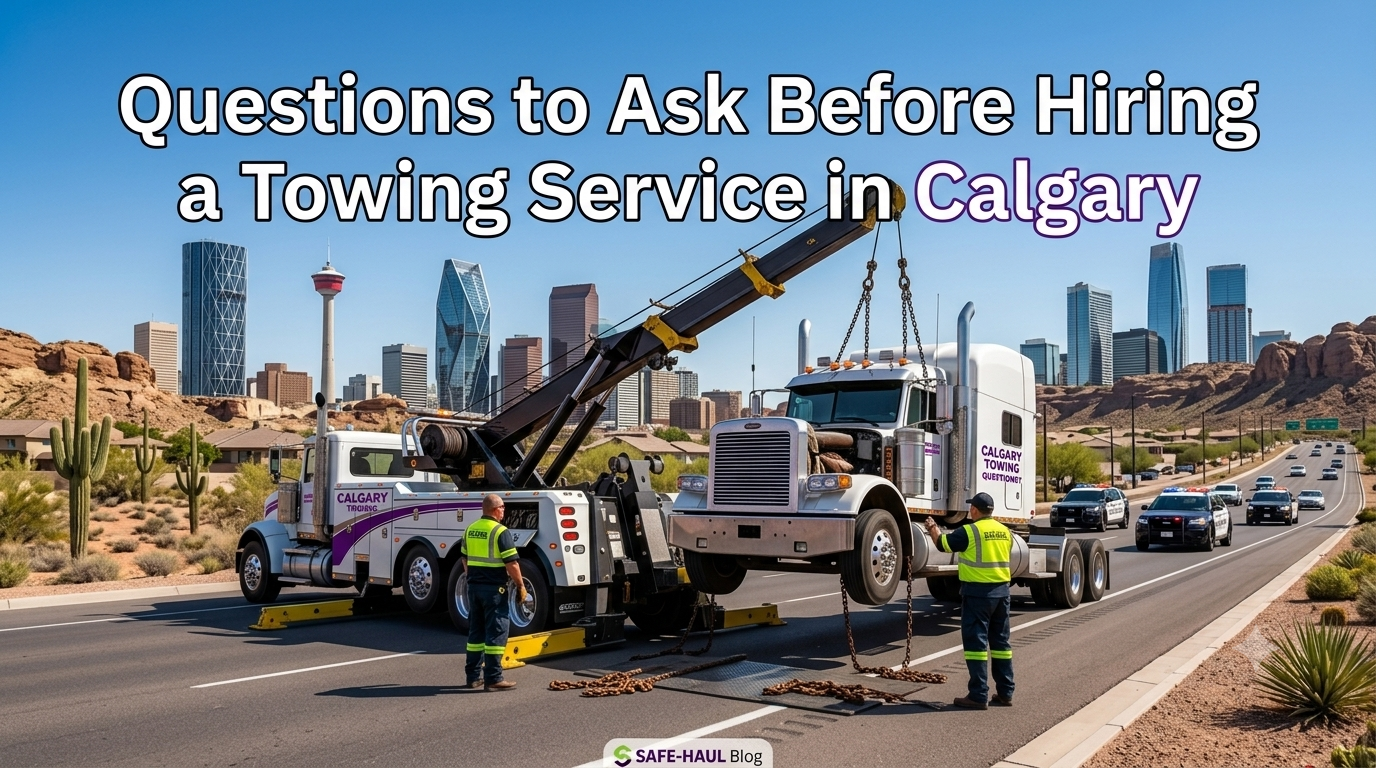
Heavy towing equipment includes hydraulic booms, air brake connections that interface directly with a commercial vehicle’s braking system, and in some cases rotator trucks capable of lifting and repositioning a vehicle at complex angles that a standard tow simply can’t achieve.
This isn’t equipment every towing company owns. Handling a fully loaded commercial truck safely takes both the right machinery and operators trained specifically on it, since a mistake at this scale carries far more risk than a passenger car recovery would.
Air brake systems in particular require specific knowledge. Connecting incorrectly can leave a vehicle without proper braking during transport, which is a serious safety issue on any road, let alone a Calgary highway at speed.
Common Situations Requiring Heavy Towing
Breakdowns on the highway, accidents involving commercial vehicles, and buses or RVs that lose power all fall into this category regularly. Large vehicle towing also applies to construction equipment and other oversized machinery that occasionally needs transport between job sites.
Each of these situations carries higher stakes than a standard car breakdown, both in terms of safety and the value of what’s actually being transported, whether that’s cargo, passengers, or expensive equipment.
Jackknifed trailers are another common scenario, requiring careful repositioning before the vehicle can even be safely hooked up for towing.
Why Commercial Downtime Is a Bigger Problem Than It Looks
A stalled delivery truck isn’t just sitting there, it’s a missed schedule, a delayed shipment, and potentially a financial penalty depending on the contract involved with the client waiting on the other end. For fleet operators, every hour a vehicle sits idle adds up quickly across the business.
This is why fast, reliable heavy towing service matters as much for the business impact as it does for basic vehicle recovery. A company that understands this urgency treats commercial calls with the priority they actually require.
What to Look for in a Heavy Towing Provider
Not every towing company handles commercial vehicles, even if their website suggests otherwise. Ask specifically about their equipment, whether they carry insurance for high value cargo, and their experience with your vehicle type before an emergency happens, not during one when there’s no time to shop around.
Look for a company that also offers standard passenger vehicle towing and specialty vehicle towing, since that range of experience usually signals a fleet capable of handling heavier equipment too, not just a single rented rig for occasional jobs.
What Happens During a Heavy Duty Recovery
A heavy duty recovery typically starts with an assessment of the vehicle’s position, weight distribution, and any cargo still on board. Operators determine whether the vehicle needs to be winched, lifted, or repositioned before towing can even begin safely.
Air brake connections get tested before the vehicle moves, and cargo is either secured in place or, in some cases, coordinated for separate handling depending on what it is. This process takes longer than a standard tow, but rushing it is exactly what leads to secondary accidents or additional damage.
FAQ
What size vehicle needs heavy duty towing?
Generally anything over 10,000 pounds, including commercial trucks, buses, and large RVs used for work or travel.
Can heavy tow trucks handle vehicles with cargo still loaded?
Yes, though this requires additional care and sometimes coordination to secure or offload cargo safely before or during the tow.
How fast can a heavy tow truck respond to a commercial breakdown?
Response time depends on location and truck availability, but experienced providers prioritize commercial calls given the financial impact of extended downtime.
Do I need special insurance for commercial vehicle towing?
The towing company should carry insurance covering high value cargo and equipment. Confirm this before choosing a provider, not after something goes wrong.
What happens if a commercial vehicle’s brakes fail during a breakdown?
Heavy duty operators are trained to safely connect air brake systems for towing, which restores controlled braking during transport to the repair location.
Conclusion
Heavy duty towing isn’t a bigger version of a standard tow, it’s a different discipline entirely, with equipment and expertise built specifically for commercial weight and complexity. Choosing a provider who actually handles this regularly protects the vehicle, the cargo, and the schedule riding on it.
Need commercial towing you can count on? Contact our team for heavy duty support across Calgary.